How Do You Calculate Odds Ratio Percentage?
To Write a Percentage as an Odds Ratio, Convert the Percentage to a Decimal X, Then Calculate as Follows: (1/X) – 1 = First Number in the Odds Ratio, While the Second Number in the Odds Ratio Is 1. Substitute Your Result from Step 3 for X in the Odds Ratio X-to-1. in This Example, the Result from Step 3 Is 1.5.
Frequently Asked Questions
Can Odds Ratio Be Percentage?
5 Answers. as Other Answers Have Clearly Articulated, You Can’t Represent an Odds Ratio as a Simple Percent Increase or Decrease of an Event Happening, as This Value Depends on the Baserate. However, If You Have a Meaningful Baserate, You Can Calculate the Percent Success (Or Failure) Relative to That Rate.
What Are Good Odds Ratios?
Odds Ratio Is a Measure of the Strength of Association with an Exposure and an Outcome. or > 1 Means Greater Odds of Association with the Exposure and Outcome. or = 1 Means There Is No Association Between Exposure and Outcome. or < 1 Means There Is a Lower Odds of Association Between the Exposure and Outcome.
What Does an Odds Ratio of 2.5 Mean?
If Odds Ratio Is 2.5, Then There Is a 2.5 Times Higher Likelihood of Having the Outcome Compared to the Comparison Group. Here the Odds Ratio Would Be 0.80. the Odds Ratio Also Shows the Strength of the Association Between the Variable and the Outcome.
What Does an Odds Ratio of One Mean?
An Odds Ratio of 1 Indicates That the Condition or Event Under Study Is Equally Likely to Occur in Both Groups. an Odds Ratio Greater Than 1 Indicates That the Condition or Event Is More Likely to Occur in the First Group.
How Do You Calculate Odds Ratios in Excel?
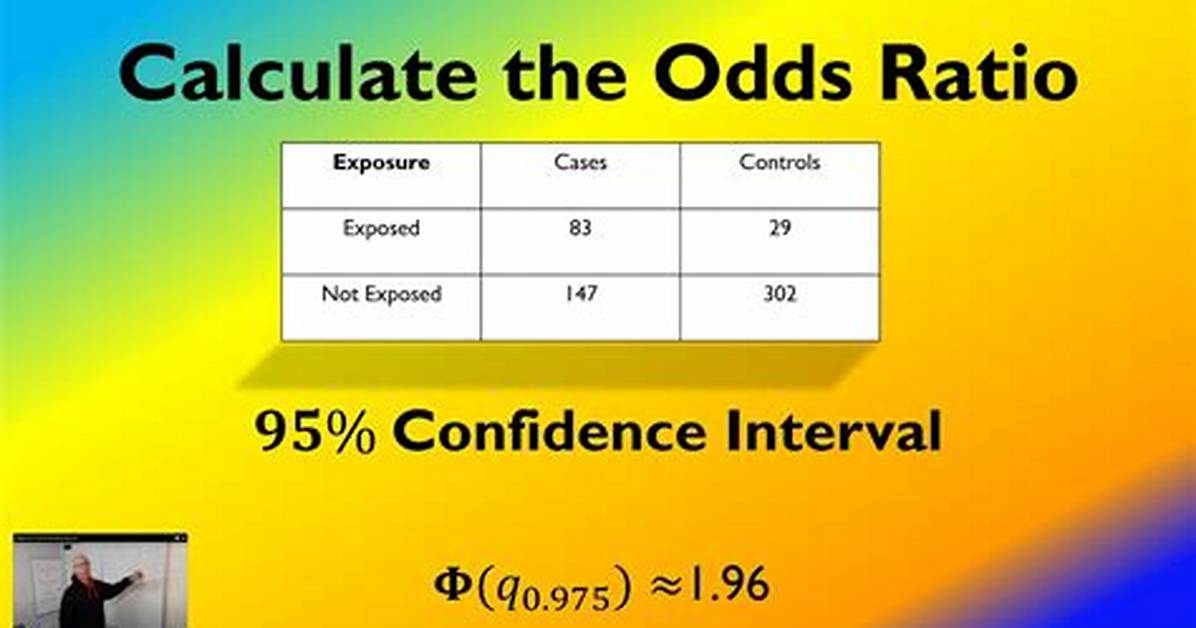
We Will Calculate Odds Ratios (Or) Using a Two-by-Two Frequency Table Open in a Separate Window Where a = Number of Exposed Cases B = Number of Exposed Non-Cases C = Number of Unexposed Cases D = Number of Unexposed Non-Cases
How Are Odds Ratios Calculated in a Frequency Table?
A) Calculating Odds Ratios We Will Calculate Odds Ratios (Or) Using a Two-by-Two Frequency Table Where a = Number of Exposed Cases B = Number of Exposed Non-Cases C = Number of Unexposed Cases D = Number of Unexposed Non-Cases
How Do You Calculate the Odds of Winning a Game?
Generally, Odds Are Expressed as the Ratio of Favorable Outcomes to Unfavorable Outcomes, Often Using a Colon. in Our Example, Our Odds of Success Would Be 2: 4 – Two Chances That We’ll Win Versus Four Chances That We’ll Lose. Like a Fraction, This Can Be Simplified to 1: 2 by Dividing Both Terms by the Common Multiple of 2.