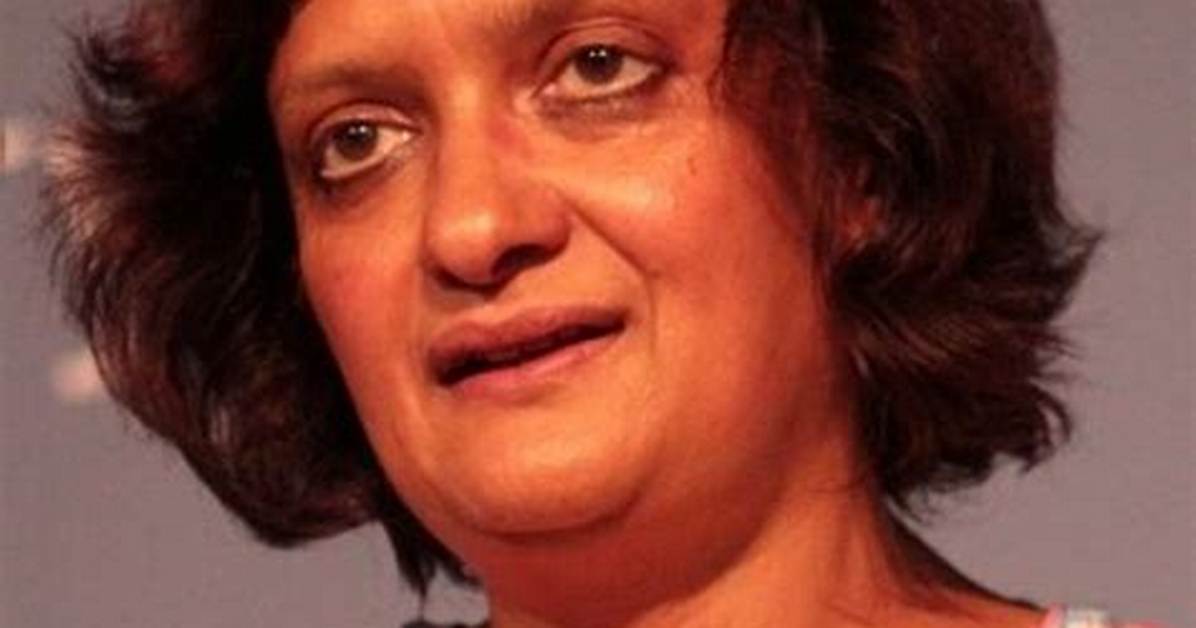
Sujata Bhatt Age, Husband, Children, Family, Biography & More » Starsunfolded
- Sujata Bhatt is an Indian poet. She is known for her anthology Brunizem (1988). She is the recipient of various awards, including the Commonwealth Poetry Prize (Asia) and the Cholmondeley Award.
- Sujata Bhatt was born at the home of her maternal grandparents in Ahmedabad, India, but she shortly moved to Pune to live with her parents. Her extended family was very close to her growing up. She was motivated to become a writer by her grandfather and uncles, who were all writers. From a young age, for all of her siblings, cousins, and friends, she was a storyteller. In an interview, she talked about telling stories since since she was very young and revealed that she used to tell stories in Gujarati but wrote the poems in English. She said,
I became the ‘storyteller’ for my brother, my cousins and friends. All my stories were told in Gujarati but my poems were written in English. I was pleased that I could use English for my poems because it enabled me to be different from my uncles. And it was because I admired them so much that I found it more liberating to write in English. I do come from a family that loves books. And I grew up during those years in India without a television.”
- When Sujata was five years old, she along with her family, moved to New Orleans, Louisiana, due to the family’s financial difficulties. After three years, her family moved back to Pune, India, when she was eight. After she was twelve, her family moved to Connecticut in the United States, leaving India once more, where she finished her formal education. During graduation, her love for literature and poetry convinced her to study philosophy in her second year of graduation, but her father wanted her to become a scientist, so she chose science in her first year of graduation. She wanted to read French philosopher and playwright Jean-Paul Sartre and Spanish poet Federico García Lorca in their native tongues, so she studied French and German in college. She worked as a research assistant and medical intern at the Johns Hopkins University Medical School after her graduation.
- In 1987, Brunizem, her debut collection, was released. Sujata claims that the majority of the poetry in her first book, which she wrote in her early twenties, talked about her longing to reunite with her homeland India, her memories and experiences there, and her detachment from it. Brunizem is a collection of sixty poems, with each section generally representing three different experiences, each of which acknowledges the messy, ever-changing history of life in various areas of Europe, North America, and India. Brunizem included the poem “Swami Anand,” which was inspired by her encounter with the Indian writer and monk Swami Anand. Some of the poems included in Brunizem are Search for My Tongue, Swami Anand, and Go to Ahmedabad.
- After Brunizem, she published many collections including Point No Point (1997), Augatora (2000), Monkey Shadows (1991), and The Colour of Solitude (2002). In the early years of her career, she composed a number of poems that were regarded as modern since they addressed subjects that were too sensitive or taboo to discuss at all. Her poetry on women’s experiences with pregnancy, childbirth, and sexual cravings included White Asparagus and The Need to Recall the Journey. For the Penguin Anthology of Contemporary Indian Women Poets, she also translated poems from Gujarati into English.
Sujata Bhatt’s book titled Monkey Shadows (1991)
- In 1992, she served as a visiting writer at the University of Victoria’s Lansdown in British Columbia, Canada. Later, she also served as a visiting fellow at Dickinson College in Pennsylvania and a Poet-in-Residence at The Poetry Archive in London.
- In 1994, Tongues Untied, a UK-based South Asian Dance Youth Company, presented her poem “Search for My Tongue” in nine cities in England and Scotland. Daksha Sheth, an Indian dancer and choreographer, choreographed the performance. The Daksha Sheth Dance Company re-presented it in 1998 at the Hong Kong Arts Festival with the same name.
- Her Literary work has been translated into more than 20 languages. She has travelled extensively in different countries and has resided in Europe, the US, and India.
- According to Sujata, she would have been a writer if she stayed in India but her need to become a poet came from being separated from her home and her native land. In an interview, she talked about the impact of moving countries on her literary work. She said,
I was reading a lot of literature in translation: writers such as Lorca, Neruda, Borges, Rilke, Celan, as well as Akhmatova and Z. Herbert – to name a few. And I kept in touch with Gujarati poetry. But all along I felt that no one really spoke for me, no one had a life as strangely disjointed as mine – and so I felt alone in my writing, I felt that my writing did not ‘fit in’ with either the Eastern or the Western tradition. The poem ‘Search for My Tongue’ (in Brunizem and in the Selected Poems) grew out of this feeling. “